After a lot of searching, I have finally found out the formula, the immigration department case officers use, to calculate whether a student has studied for two years or not.
Here is the formula.
T=L X C/U , where:
T= Duration for which the student studied the course
L= length of course on CRICOS
C = number of units completed by student, excluding exemptions
U = number of units which would be necessary to complete the studies
Hope this helps all those who are not clear about the two year study rule.
Kind Regards
Junaid
Migration Agent Registration Number: 0964018
Showing posts with label Two year Rule. Show all posts
Showing posts with label Two year Rule. Show all posts
Wednesday, October 22, 2008


Sunday, October 28, 2007
The Two year rule
PLEASE NOTE THAT AS OF 23RD MARCH, 2013, International students can no longer directly apply for PR after studying for two years.
The two year rule is still valid in many situations. However, International students should not be tricked into believing that they can get PR just by studying for two years in a degree which is closely related to a profession on the SOL.
Please see the below links.
http://www.immi.gov.au/students/knight/faq-post-study-work-arrangements.htm
http://migrationblog.immi.gov.au/2013/01/10/new-post-study-work-arrangements-and-international-students/
____________________________________________________________-
What is the two year rule?
Its very important to understand the two year rule.
In addition:
These changes benefit students because they allow more flexibility.
What is two academic years?
Examples:
Example 1:
If a course is CRICOS registered for 138 weeks (3 years) and consists of 24 units, 100% of full-time enrolment would equate to 8 units per year. In that course, a student will have completed two academic years when they have successfully completed 16 units. That means a student enrolled in that course can be given credit for prior learning for up to 8 units and still complete two academic years study.
Example 2:
If a course is CRICOS registered for 92 weeks (2 years) and consists of 12 units, 100% of full-time enrolment would equate to 6 units per year. Students would be required to complete all 12 units to meet the two year study requirement.
A student enrolled in this course who is given any credit for prior learning will not have completed two academic years study and may have to complete an additional degree, diploma or trade qualification to meet the two year study requirement.
My case:
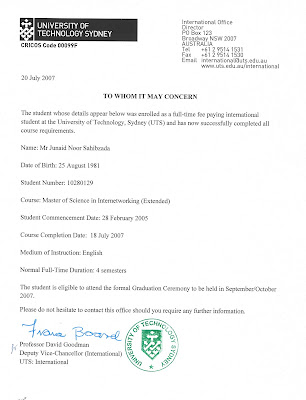
Certificate of completion issued to me by UTS at the end of successfull completion of my degree.
Junaid
Migration Agent Registration Number: 0964018
The two year rule is still valid in many situations. However, International students should not be tricked into believing that they can get PR just by studying for two years in a degree which is closely related to a profession on the SOL.
Please see the below links.
http://www.immi.gov.au/students/knight/faq-post-study-work-arrangements.htm
http://migrationblog.immi.gov.au/2013/01/10/new-post-study-work-arrangements-and-international-students/
____________________________________________________________-
What is the two year rule?
Its very important to understand the two year rule.
The two year study requirement was introduced in July 2003 in recognition of the value of Australian study in equipping visa holders to find skilled employment and settle easily in Australia. The intention of the two year study has always been to ensure that applicants for GSM have a strong foundation of at least two academic years study in Australia. The value arises not only from having an Australian qualification but from having substantial exposure to Australian society and culture.
The Government has amended the Regulations to clarify the two year study requirement in response to some confusion surrounding its interpretation.
From 1 September 2007, to meet the two year study requirement, applicants will have to complete one or more degrees, diplomas or trade qualifications for award by an Australian educational institute as a result of a course or courses:
From 1 September 2007, to meet the two year study requirement, applicants will have to complete one or more degrees, diplomas or trade qualifications for award by an Australian educational institute as a result of a course or courses:
- Registered on the Commonwealth Register of Institutions and Courses for Overseas Students (CRICOS);
- Completed as a result of at least two academic years’ study;
- Completed in a total of no less than 16 calendar months; and
- That the applicant studied in Australia, while holding a visa that allowed study and for which all instruction was conducted in English.
In addition:
- Students will not be penalised for changing education providers provided they obtain credit for their previous study and this study was in a CRICOS registered course undertaken in an Australian institute while physically present in Australia and in accordance with any visa conditions.
- In line with the National Code 2007, students will also be able to count study undertaken online towards meeting the two year study requirement (up to 25%), if they were in Australia for the duration of that period of study.
These changes benefit students because they allow more flexibility.
What is two academic years?
To demonstrate that you have studied for at least two academic years, you must show that you have completed the equivalent of two years study at 100% of a full-time load. If you are given credit from prior learning it will reduce the amount of study you have completed.
The department will use CRICOS to determine whether a course meets the two year requirement. From 22 October 2007 a course that has a registered duration of 92 weeks will be accepted as a course equating to two academic years of study.
Examples:
- If a student completes a full qualification in a course that is registered as 92 weeks, they will have met the two year study requirement.
- Where a student completes two eligible qualifications, each related to their nominated occupation, that together total at least 92 weeks registration on CRICOS, they will have met the two year study requirement.
- Where a student enrols in a three year full time course, they can be granted recognition of prior learning or credit for up to one year of full-time study and still meet the two year study requirement (as defined above) when they complete the qualification.
- Where a course is CRICOS registered for 92 weeks a student enrolled in this course who is given any credit for prior learning will not have completed two academic years of study. In this situation, the applicant would need to have (or complete) an additional eligible qualification related to their nominated occupation in order to have completed, in total, the required two years of academic study.
- If a course is CRICOS registered for 92 weeks but a student elects to complete the course through accelerated learning, for example through a summer semester of study, the student is considered to have met the two year study requirement if they complete the course in no less than 16 calendar months.
- If a student enrols in a course that would only require 1.5 years to complete full-time but has taken two years to complete, this will not have met the requirement for two years of academic study.
Example 1:
If a course is CRICOS registered for 138 weeks (3 years) and consists of 24 units, 100% of full-time enrolment would equate to 8 units per year. In that course, a student will have completed two academic years when they have successfully completed 16 units. That means a student enrolled in that course can be given credit for prior learning for up to 8 units and still complete two academic years study.
Example 2:
If a course is CRICOS registered for 92 weeks (2 years) and consists of 12 units, 100% of full-time enrolment would equate to 6 units per year. Students would be required to complete all 12 units to meet the two year study requirement.
A student enrolled in this course who is given any credit for prior learning will not have completed two academic years study and may have to complete an additional degree, diploma or trade qualification to meet the two year study requirement.
My case:
I will explain my own example to make things easy for understanding.
You can see the certificate of completion from my university below.
Certificate of completion issued to me by UTS at the end of successfull completion of my degree.
As you can see the certificate shows two things
- The start date and the end date, which is from 28th of Feb, 2005 to 18th of July, 2007. A total of 29 months OR 116 weeks.
- The other important thing mentioned is the "Normal full time duration" of the course which is 4 semester (2 yrs or 52 weeks).
Although I completed the course in an extra 6 months, the actual duration of the course is 2 yrs, NOT 2.5 yrs.
So when the immigration department opens your case file, it will look at two things
1. The official course duration as listed on the CRICOS website. In my case, my course is 104 weeks.
You can check that by clicking on the link for CRICOS website.
You can check that by clicking on the link for CRICOS website.
2. The total duration of the course in a full time load as shown by the certificate of completion on the letter issued to you by your university.
I hope I have cleared the doubts of every one by providing my own example.
Kind Regards
Junaid
Migration Agent Registration Number: 0964018
Subscribe to:
Posts (Atom)