Since I have been receiving large volumes of email requesting me to explain in detail about how to migrate to Australia, I will try to answer this not-easy-to-answer question over here.
You can migrate to Australia by following
different path ways.
One such path way is by coming to Australia as an international student and then applying for Permanent Residency, PR.
The point to note while applying for PR is that you have to gain certain number of
points. If you can score the required points, you get PR. If not then you have to do some thing else to get extra points to be eligible for PR.
How much points you have to score? That depends on the type of immigration you are applying for. For a complete list of different categories of immigration, please check
this post.
Once you have determined which category you have to apply through, you look up the required score for your category. For example, these days, the score required for International students is 120. For a complete list of scores for different categories,
check this post.
Once you have determined what the required score is, you go about calculating whether you can score that much points or not.
So this is a brief over view of how to immigrate to Australia.
1. Chose your category.
2. Check the score for that category.
3. See if you can score that many points or not.
Now there are two ways to immigrate. On shore and offshore immigration. I have explained both of them in the post mentioned above. You can visit it
here.I will first explain the process of immigrating for those people who want to immigrate to Australia as international students.
Immigrate to Australia as an International StudentThe reason most people are interested in coming to Australia as an international student is because later on they want to apply for PR and get settled down in Australia. If you are one of them then read what I have written below.
If you want to apply for PR after completing your post graduate degree, you need a great deal of planning. You need to have the precise knowledge of how many points you will get once you finish your degree and whether you can then apply for PR with that number of points or not. If not, then what is the way to make up for those points. Make sure you know ever thing before you come to Australia. It would be of no use if you complete your only to know that you are short of 5 points. You will be left high and dry in the middle of no where and your whole two years of emotional, physical, financial and academic investment would be ruined.
Ok enough of advices. Time to get down to the basics.
Step 1.If you want to immigrate to Australia, you need to have some thing which Australia needs. A particular type of Skill which is in demand in Australia.
How can you tell if the skills you have are in demand or not?
You can check that from the
Skilled Occupation List SOL, or the
Most on Demand List, MODL.
There is no difference between SOL and MODL except that certain professions on SOL are in high demand and therefore placed on MODL. If you have skills of an occupation listed on MODL, you will claim bonus points for that.
What if my profession is not on SOL?If your profession is not on SOL, you will score less points then those whose occupations are listed on SOL. So all you have to do is to get those extra points from other alternative means to cover up for your occupation not being in SOL.
Check this post to see how to get extra bonus points.
What next?The
next step is to apply for an admission in an Australian university for a post graduate degree which is
closely related to the profession of your choice. I will deal with undergraduate degrees later on.
This profession of choice would be the same as the one you have chosen on SOL. Please note that the word "closely related" is very technical in nature and you should be completely sure that your degree IS actually closely related to your choice of profession.
You are also supposed to be enrolled in a course which is a valid
CRICOS course. If you enrol in a course which is not a valid CRICOS course, you are not eligible for PR.
How Do I know that my degree will fetch me 60 points or not?
That's pretty easy. Simply check the website of your assessing authority's website and see if the degree you are undertaking is listed on the website or not. If it is, then how many points is it worth for?
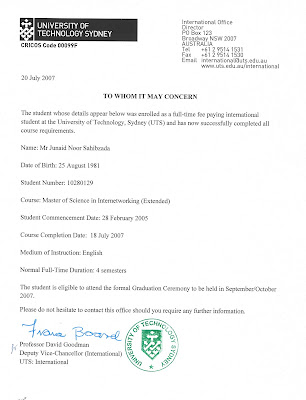
For example, I did a 2 years MSc Internetworking Extended from UTS. My assessing authority is Australian Computer society, ACS. The ACS lists all the degrees from all the universities of Australia, which it recognises as valid degrees and also assigns scores to those degrees. ACS has listed my degree as worth 60 points.
Since the time I wrote this article, ACS has revamped their website and now instead of mentioning the number of points, they simple mention if the degree is of professional level or associate level. So what you need to do is that you contact ACS and ask the question
"If I complete the degree ABC, would I be able to get a positive skills assessment in profession XYZ which has the ASCO code 1234 on the SOL? You can also ask ACS if a degree being associate or professional has any effect on getting a positive skills assessment for a particular profession."Actually I will myself ask this question from ACS and if they respond I will put their response here as many people have asked me the same question.Similarly, you check the website for your assessing authority for the degree you are doing.
The assessing authorities are listed on the SOL and MODL.
Two Years studyAlso you should remember, that to be fulfil the prerequisites of PR, you should have studied in Australia for two years. What does that mean? Check this
post. Understanding the two year rule is very necessary.
The bottom line is that before you apply for PR, you should have studied in degrees, diplomas or trade certificates for a total official period of 92 weeks.
If your degree was of 52 weeks but you completed it in 92 weeks, it will still be considered as 52 weeks NOT 92 weeks. Check the post for more details.
You can complete these 92 weeks by studying one degree or by studying multiple degrees, diplomas or trade certificates.
Ok I have finished my degree now what? Congrats! Apply for PR! What else? But it would be wise to consult a lawyer before you do that just to make sure if things are in the right order or not.
This was a brief primer to immigration to Australia for International students.
I will discuss immigration for other professionals who dont want to spend money in over post graduate education and want to apply for offshore immigration. Visit this post for updated information.
A few facts about Skilled independent Visa Sub class 885.
The 885 visa sub class allows overseas students who have completed their course studies in Australia and holders of certain temporary visas to apply for permanent residency.
This visa uses a points test to select visa applicants with characteristics needed in the Australian labour market.
You do not require sponsorship to apply for this visa.
Who is this visa for?
This visa is for you if you are in Australia and you are one of the following:
- an overseas student or former overseas student
- a holder of a Skilled – Graduate (subclass 485) visa or Skilled – Recognised Graduate (subclass 476) visa
- a holder of a Trade Skills Training (subclass 471) visa.
You must:
- be under 45 years of age
- have good English language skills
- have the skills and qualifications that meet the Australian standard for an occupation on the Skilled Occupation List (SOL) and your nominated occupation is classified as either:
- a 60 point occupation
or - a 50 point occupation
The SOL is a list of skilled occupations that are in need in Australia. Each occupation listed on the SOL is allocated a points value for use in the visa assessment process.
See: Form 1121i Skilled Occupation List (SOL) and Employer Nomination Scheme Occupation List (ENSOL) (129KB PDF file)
How much does this visa cost?
You must pay the relevant visa application charge when you lodge your visa application.
See: Professionals and other Skilled Migrants
What does this visa let me do?
This visa allows you and any secondary applicants included in your visa application to live as permanent residents in Australia.
Australian permanent residents can:
- live and work in Australia on a permanent basis
- study in Australia at school or university
- receive subsidised healthcare through Medicare and the Pharmaceutical Benefits Scheme (PBS)
- access certain social security payments (subject to waiting periods)
- be eligible for Australian citizenship (subject to the residency eligibility criteria)
- sponsor people for permanent residence.
-------------------------------------------------------------------
Junaid Migration Agent Registration Number: 0964018